
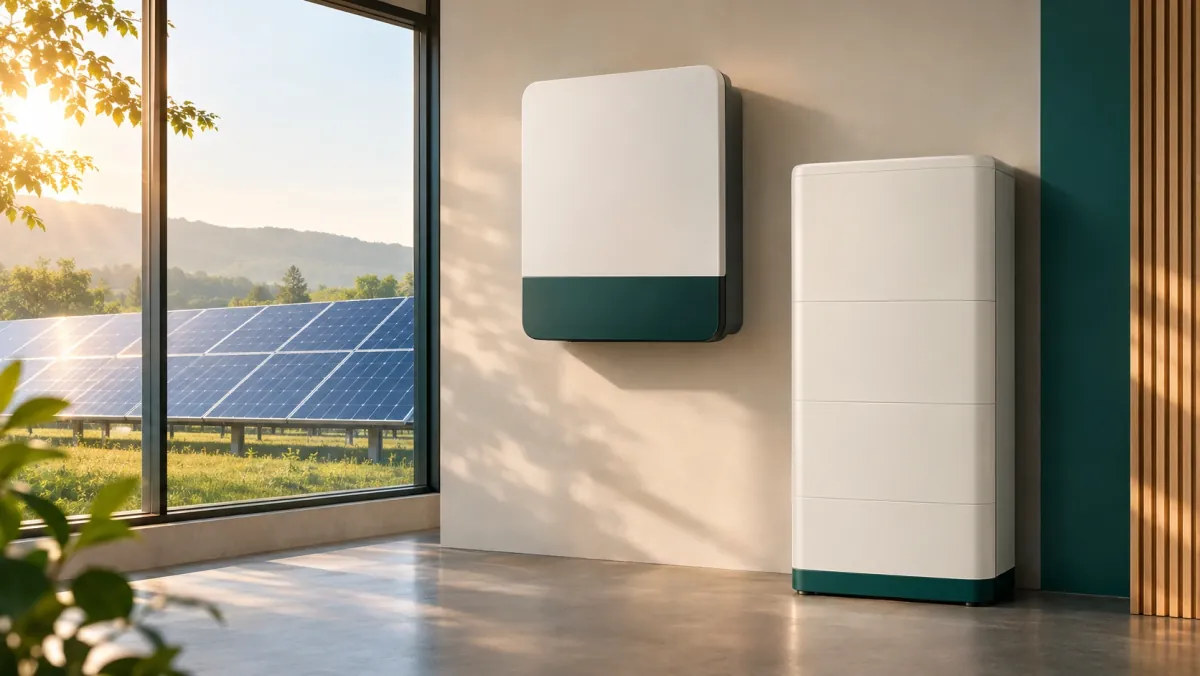
A hybrid solar inverter combines solar power conversion with functions for working with a battery. Depending on the model and system design, it may also manage power flows between solar panels, battery storage, loads and the electricity grid. The word “hybrid,” however, does not guarantee that a particular inverter supports every battery, operates without the grid or provides backup to every circuit.
For a business buyer, the question is not simply “How many kilowatts is it?” A useful specification must identify the PV array, AC loads, battery, intended operating modes and destination. This guide explains the main decisions and the information to request before ordering.
What is a hybrid solar inverter?
Solar panels produce direct current (DC), while typical building loads use alternating current (AC). A solar inverter converts power for AC use. A hybrid inverter adds battery-related power conversion and control functions, although the exact connections, charging functions and modes vary between products.
A simple way to think about the system is:
- PV array: produces DC power when sunlight is available.
- Hybrid inverter: manages conversion and, where designed to do so, coordinates power from PV, the battery and other permitted sources.
- Battery: stores energy within its allowable operating limits.
- Loads and grid: receive or exchange power only as supported by the equipment and project design.
Some hybrid inverters can be installed before a battery is added. That does not mean any battery can be connected later. Check the inverter's model-specific battery requirements, operating modes and supported configurations before purchase.
Hybrid inverter vs off-grid inverter vs grid-tied inverter
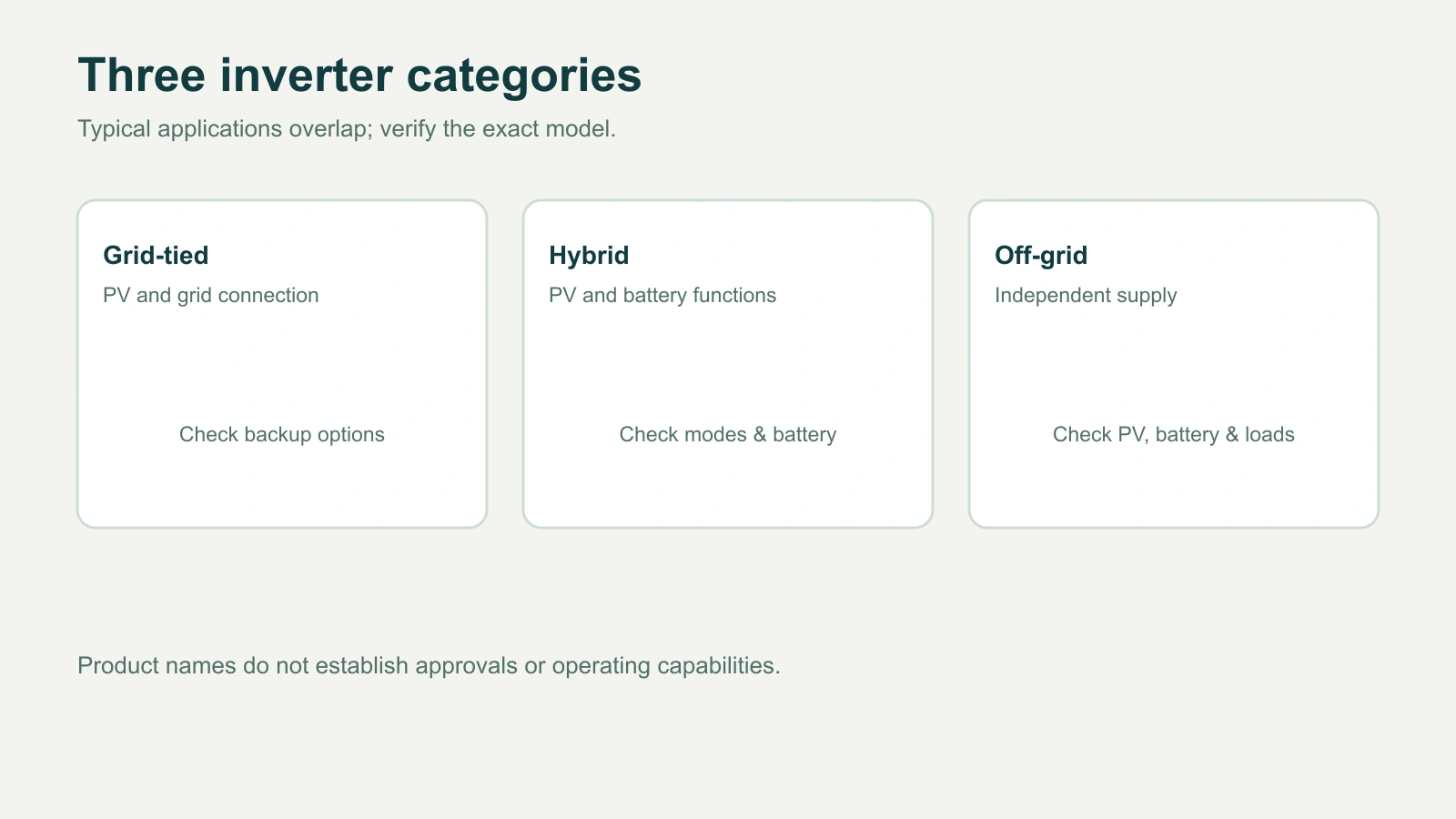
| Type | Typical role | Question to verify |
|---|---|---|
| Grid-tied solar inverter | Converts PV power for an interconnected system | Can the existing design add storage or backup, and what equipment is required? |
| Hybrid inverter | Combines PV conversion and battery-related functions | Which batteries, grid modes and backup functions does the exact model support? |
| Off-grid solar inverter | Supplies an independent system when configured with suitable equipment | What PV, battery and load conditions does the model require? |
These are broad descriptions. Product names overlap, and an off-grid solar inverter may be sold in an all-in-one package with charging features. Use the datasheet and installation manual, rather than the category name alone, to identify what the exact equipment can do.
A hybrid inverter designed for grid connection is not automatically approved for every utility or jurisdiction. Likewise, “battery-ready” does not by itself mean that a battery and the required backup equipment are included.
How does a hybrid inverter work?
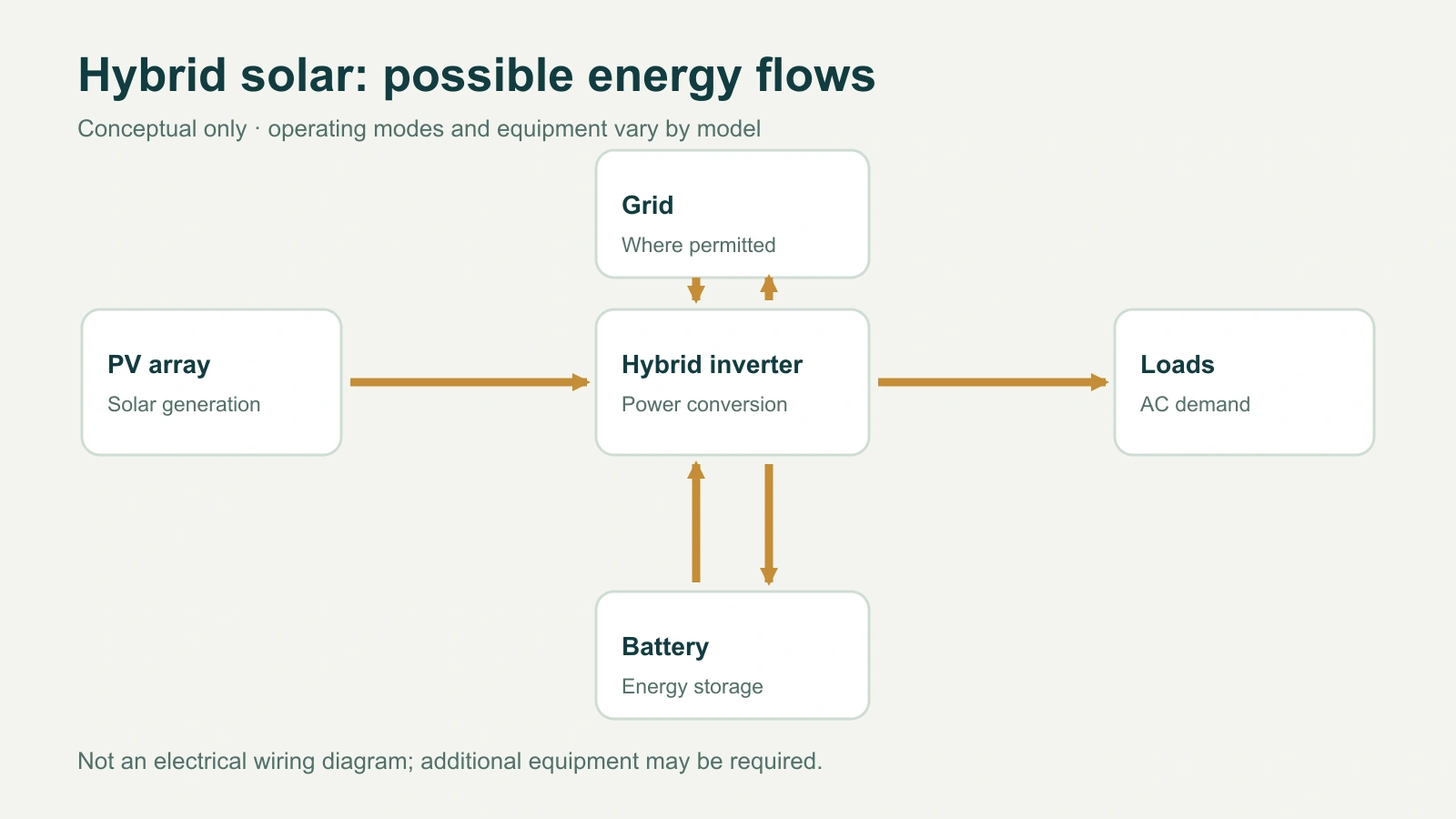
During sunny conditions, a compatible system may use PV power for AC loads and charge its battery when conditions and settings allow. At other times, the battery may supply loads through the inverter. A grid-connected installation may also import or export power if the equipment, utility agreement and local rules permit it.
During an outage, a system designed and equipped for backup may disconnect or isolate the backed-up circuits as required and supply selected loads. The actual behavior depends on the inverter, battery, transfer or isolation equipment, wiring and project design. Ask specifically which circuits can be backed up, whether additional equipment is needed and what output limits apply in backup mode.
The US Department of Energy's overview of solar and storage explains why storage and suitable power-conversion equipment are relevant when energy is needed after solar production. Treat that general explanation as a starting point; use the exact equipment documentation for design and procurement.
How to choose a hybrid solar inverter
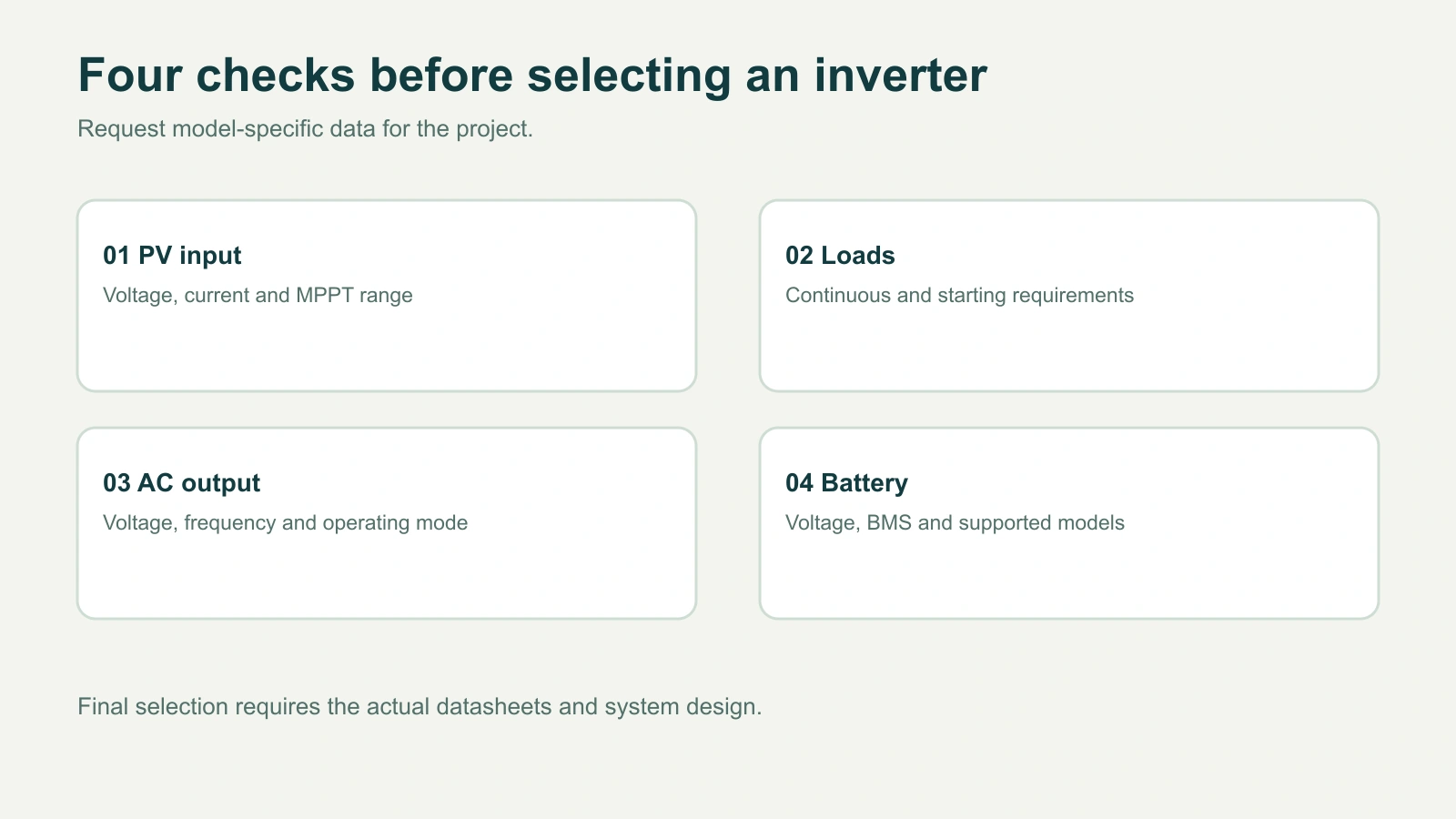
1. Define the loads and the required operating mode
List the loads that must operate together. Separate normal operation from backup operation, and identify equipment with significant starting requirements, such as motors or compressors. Compare those needs with the inverter's continuous AC output, surge capability, output duration and any backup-specific limits.
A 5 kW inverter rating is not a statement that it can start every combination of appliances. Similarly, battery energy measured in kWh describes stored energy, while inverter output measured in kW describes a power limit. Both matter, along with battery discharge capability and system losses.
Include in the RFQ: continuous load estimate, the largest starting loads, required backup circuits and whether grid-connected, off-grid or both modes are needed.
2. Check PV input and MPPT limits
Review the inverter's maximum PV input voltage, MPPT operating range, input current limits, number of trackers and permitted string configuration. Then compare those limits with the actual module datasheet and planned series/parallel arrangement.
Cold conditions can increase module open-circuit voltage. A string that appears acceptable at a mild temperature still needs a cold-condition voltage check. The project designer should also verify current and other relevant operating limits. The NAZ Solar Electric inverter buying guide separates PV input and AC load sizing for this reason.
Include in the RFQ: module model, module Voc, Vmp, Isc and Imp, the proposed string layout and site location or design temperature.
3. Verify the battery and BMS
If a project uses a lithium battery, check the inverter's allowable battery voltage range and charge/discharge limits against the exact battery. A hybrid solar inverter 48V listing is only a starting point: two products described as 48 V do not necessarily communicate or operate together.
Ask for the manufacturer's supported battery list, required communication protocol, port and cable, firmware, parallel configuration rules and any limits that apply to the pairing. A matching CAN or RS485 label alone is not proof of compatibility. See our separate battery and inverter compatibility guide for the purchasing checklist.
Include in the RFQ: complete battery and inverter models, voltage range, usable capacity target, required continuous power, BMS information and expansion plans.
4. Confirm AC output, backup and destination requirements
US projects may require particular AC voltage, frequency and phase configurations. Some applications require split-phase 120/240 V, while others do not. Confirm the actual project's service and the selected model's output rather than assuming an inverter sold internationally meets a US installation's needs.
For backup, request the specific output rating in that mode, the circuits supported and any required external transfer or isolation equipment. Also ask for model-specific documentation relevant to the utility and local authority. Approval depends on the actual product, system and jurisdiction.
5. Compare complete quotations
Two quotes may appear to describe the same inverter but include different equipment. Check whether each quotation identifies the exact model, PV inputs, included accessories, battery connection hardware, communications, required transfer equipment, packaging and delivery terms.
Ask for a current datasheet, installation instructions, applicable certification documents and model coverage, warranty terms, availability and lead time. Do not assume a certificate for a related product or component covers the full proposed system. UL Solutions distinguishes the evaluation of energy storage systems from that of individual components.
A practical hybrid inverter RFQ checklist
| Information to provide | Why it matters |
|---|---|
| Application and destination | Determines operating and documentation requirements |
| Continuous and starting loads | Helps assess AC output and surge needs |
| PV module and string details | Allows voltage, current and MPPT limits to be checked |
| Battery model, voltage and BMS | Supports model-specific electrical and communication review |
| Desired operating and backup modes | Identifies required functions and additional equipment |
| Quantity, schedule and shipping destination | Allows quotation, packing and delivery terms to be assessed |
If an item is unknown, state the application and mark the specification as needing review. A complete and accurate answer is more useful than an assumed model number.
Discuss inverter requirements with us
Explore our hybrid and off-grid inverter reference product or send an inquiry with your PV array, battery and load requirements. Product imagery is illustrative; the exact model, configuration, documents and commercial terms must be confirmed before ordering.
Browse our solar and energy storage product range for more project sourcing options.
Technical sources: US Department of Energy, Solar Plus Storage; NAZ Solar Electric, Inverter Buying Guide; UL Solutions, Energy Storage System Testing.
FAQ
Can a hybrid inverter work without a battery?
Some can, but not every product has the same installation or operating requirements. Confirm the manufacturer's instructions and whether the functions you need are available without a battery.
Does every hybrid inverter provide backup during an outage?
No. Backup depends on the selected inverter, system design and any required battery, isolation or transfer equipment. Confirm the supported circuits and output in backup mode.
Is every 48V battery compatible with a 48V inverter?
No. “48V” is a nominal description. The operating voltage range, current limits, BMS protocol, connection and firmware must be checked for the exact models.
Is PV input power the same as AC output power?
No. PV input and AC output are different parts of the equipment and may have different ratings and limitations. The design must satisfy voltage and current limits as well as power ratings.
What should a US buyer verify first?
Start with the required AC output configuration, frequency, intended operating mode and project location. Then request the selected model's datasheet, installation instructions and documentation needed for the particular project.