
Inverter Battery Compatibility: How to Check a Solar Battery Before Buying
Check inverter battery compatibility using model numbers, voltage ranges, current limits, BMS communication and manufacturer documentation.
Inverter battery compatibility is a model-specific question. A battery and an inverter both described as “48V” may still have different operating voltage ranges, current limits or communication requirements. Before ordering, identify the exact equipment and check its electrical data, battery management system (BMS), connection requirements, firmware and manufacturer documentation.
This is especially important for installers, integrators and distributors who may be asked to combine components from different suppliers. A photograph, a shared nominal voltage or a “CAN” port label is not enough to establish that a proposed pair is supported.
The checklist below helps you gather and compare the right information. It is a procurement and review framework; the final design and installation must follow the exact manufacturers' instructions and the requirements applicable to the project.
Why does battery and inverter compatibility matter?
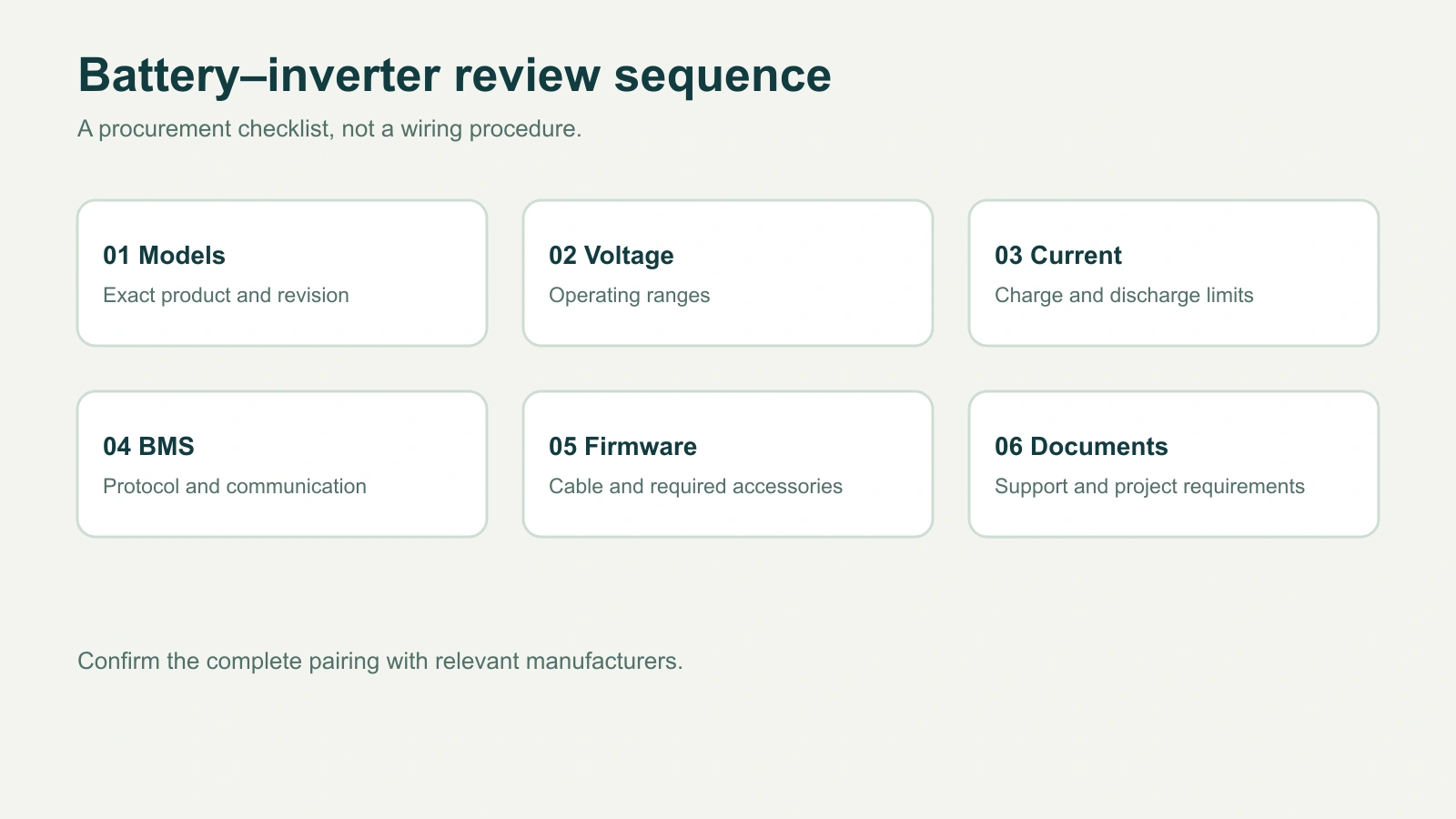
A compatible arrangement needs more than a physical connection. The battery must operate within its permitted voltage, current, temperature and other limits; the inverter and any charging equipment must also remain within theirs. Where the design relies on BMS communication, the components must be able to exchange the information and commands required by that specific system.
An unsuitable pairing can cause communication faults, unexpected shutdowns or operating limitations. It can also complicate warranty support or project approval. Conversely, a functioning cable connection does not by itself prove that the complete system is supported or that the correct operating limits are being applied.
The Victron Energy battery compatibility documentation illustrates the value of model-specific guidance for lithium batteries and their management systems. Its product list is for the Victron arrangements described there; it is not a compatibility list for products sold by another supplier.
Step 1: Identify the exact battery and inverter
Gather the documents before comparing specifications:
- Battery manufacturer, complete model number, chemistry and nominal voltage.
- Inverter manufacturer, complete model number, regional variant and its battery input or supported battery configuration.
- Battery and inverter datasheets, installation instructions and the applicable compatibility list.
- Firmware versions, communication accessories and cables, if relevant.
- Intended use: new installation, adding storage to an existing system, backup or an off-grid application.
If there are multiple modules, record their number, model and intended parallel configuration. A family name is not always enough: revisions, regional variants or minimum supported firmware can change the conditions of a supported pairing.
If either supplier cannot identify the precise model or document version, mark compatibility as unconfirmed. Ask the relevant manufacturer or supplier for written confirmation rather than assuming that a similar-looking unit is equivalent.
Step 2: Compare voltage ranges—not just the 48V label
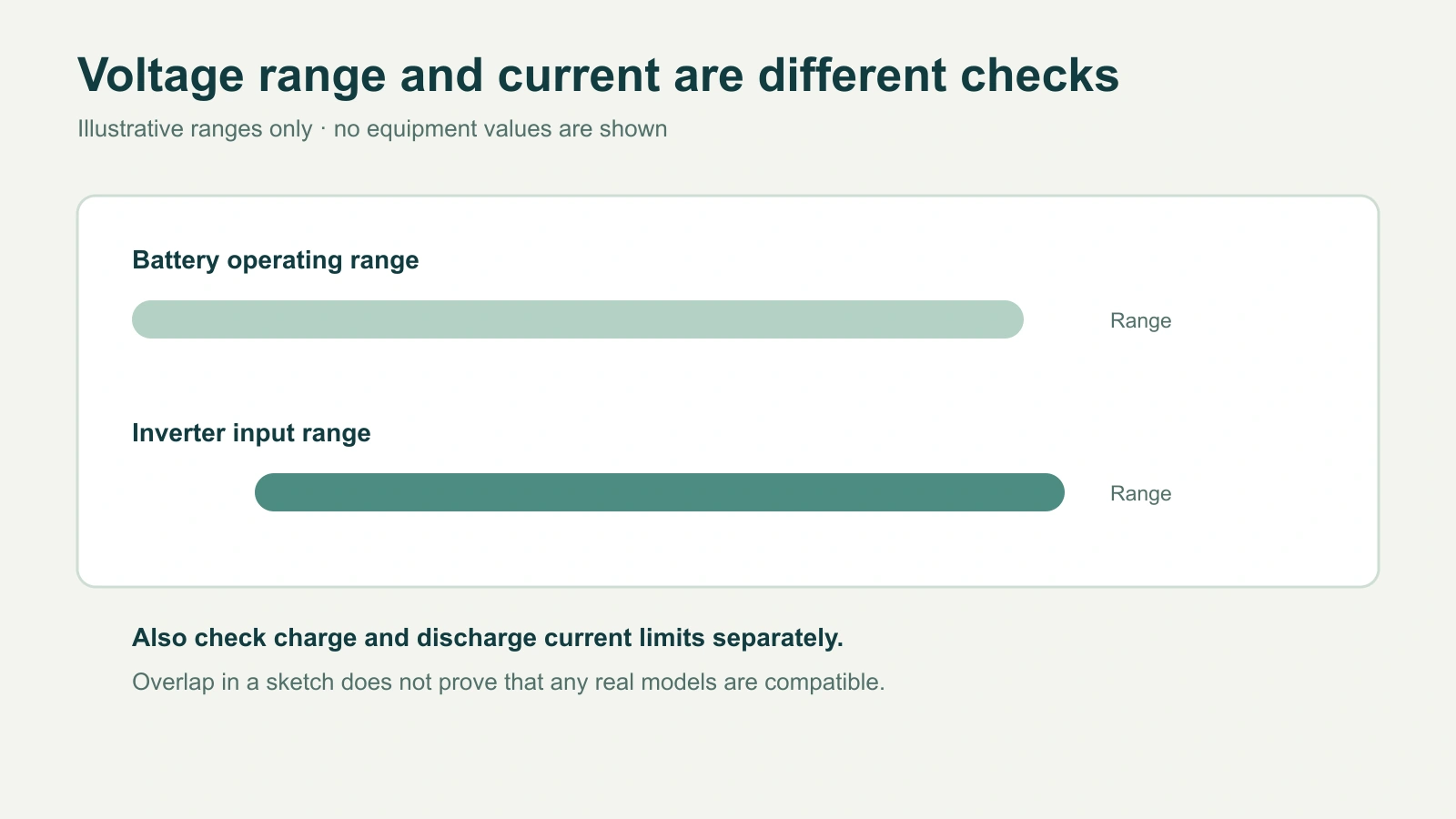
Nominal voltage is a convenient category, not the complete operating envelope. To review a 48V solar battery, compare the battery manufacturer's permitted operating, charging and discharging ranges with the inverter's specified battery input and charging ranges for the intended mode.
Also check the conditions attached to the published ranges. The allowed operating behavior can depend on battery temperature, state of charge, BMS limits and system configuration. The equipment designer should confirm how the full battery range and required protective thresholds fit the inverter and any additional charging sources.
For example, if one document only says “48V nominal” and the other gives a voltage range, there is not enough information to approve the pair. Request the full operating limits and the manufacturers' installation instructions. Do not copy settings from a different battery, even if it has the same nominal voltage.
A LiFePO4 solar battery needs model-specific checks
A LiFePO4 solar battery describes a chemistry, but two products with that chemistry can still differ in BMS behavior, allowable current, operating temperature, communication and expansion rules. Chemistry and nominal voltage help narrow the search; neither establishes a supported system by itself.
Step 3: Check charging and discharging current
Look for the battery's maximum continuous charge and discharge current, any permitted peak limits and their durations, and the limits enforced by its BMS. Compare these with the inverter's charging capability and the current needed for the intended loads.
Power and energy answer different questions. Battery capacity in kWh helps describe how much energy is stored. Current limits and inverter power affect how much power can be delivered at a given time. A battery may have sufficient energy for the desired runtime but still be unable to support a particular continuous or starting load.
For an early project discussion, collect these values:
| Item | Ask the supplier or designer for |
|---|---|
| Battery energy | Nominal and usable capacity, including the conditions used |
| Continuous discharge | Allowable continuous current or power at the stated conditions |
| Peak discharge | Limit and permitted duration, if specified |
| Charging | Maximum charging current and any temperature-dependent limits |
| Inverter output | Continuous and surge ratings for the intended operating mode |
| Expansion | Approved number and combination of modules, plus any parallel limits |
This table identifies what to compare; it does not replace a model-specific calculation. Do not assume multiple batteries can be combined simply by multiplying one module's rating: the manufacturer may impose system-level and configuration limits.
Step 4: Verify BMS communication
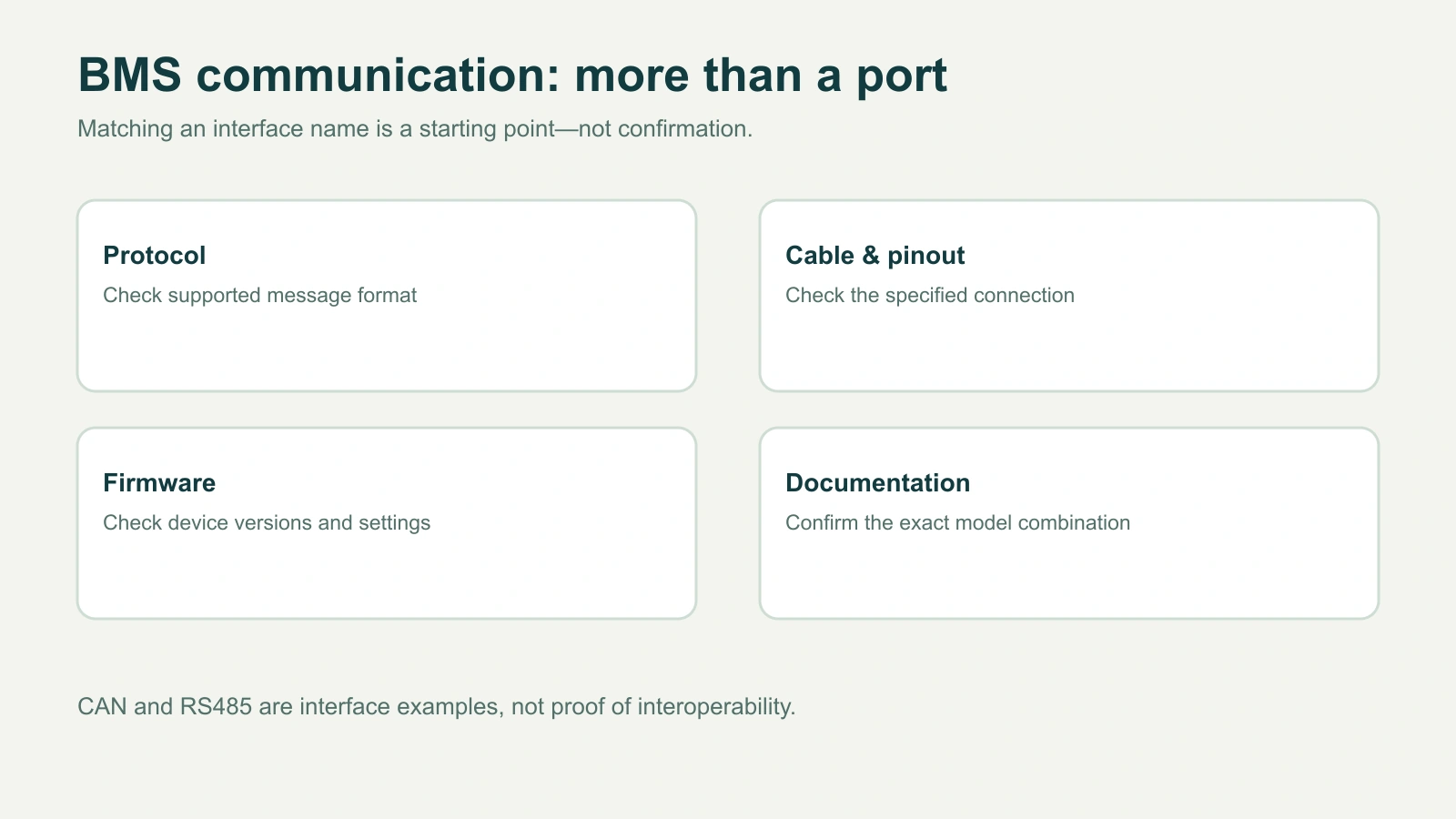
A BMS monitors and protects the battery and, in systems designed for communication, may share operating information with other equipment. Depending on the supported combination, that information can include state of charge, charge and discharge limits, warnings or fault conditions.
CAN and RS485 are starting points, not proof
An inverter and battery may each advertise CAN or RS485 and still require a specific protocol, pinout, cable, communication device or firmware. The interface name tells you something about the connection, but it does not establish that both devices interpret messages in the same way.
Ask both suppliers:
- Is the exact inverter and battery combination listed or otherwise documented as supported?
- Which protocol, port and cable are required? Is a gateway or communication device needed?
- What minimum firmware versions and settings are specified for this combination?
- Does the supported configuration change when batteries are connected in parallel?
- What evidence should the installer check to confirm the intended communication is active?
For illustration, Victron's instructions for a particular BSLBATT arrangement specify a communication device, cable and firmware conditions. Those details apply to the products and configurations described in that document only; they are not universal requirements or evidence that our candidate battery works with those models.
What if the battery is not on a compatibility list?
A missing listing is not automatic proof that a pairing can never work. It does mean the available list has not established the pairing for your review. Ask the manufacturers or responsible suppliers whether they support the exact combination and under what conditions. Obtain current documentation and clarify who is responsible for support and warranty.
Some equipment offers modes that do not use the same closed-loop communication arrangement. Whether a particular mode is allowed and appropriate depends on both products and the project. Do not bypass communication or copy manual settings without the manufacturers' documented approval and a qualified system review.
Step 5: Review the system and purchase documents
Compatibility also depends on the intended installation. Request the exact equipment documents and confirm:
- System configuration: the number of battery modules, supported expansion, inverter operating mode and additional charging sources.
- Installation environment: allowable temperature, location, ventilation and enclosure requirements in the selected product manuals.
- Applicable documents: installation instructions, model-specific certificates, product markings and the documentation required by the destination and project.
- System-level evidence: whether the relevant project requires documentation for the complete battery–inverter arrangement, not only individual components.
- Commercial support: warranty conditions, responsibility for technical support, replacement procedure, lead time and delivery terms.
For US projects, ask the installer and the authority responsible for the project which documentation applies. UL Solutions explains that energy storage system evaluation considers system functions and references standards for relevant components. A component document should not be presented as proof that an assembled system is certified. No certification is claimed here for an unverified product.
Common compatibility mistakes
| Assumption | Better question to ask |
|---|---|
| “Both products say 48V, so they work together.” | Do the actual battery operating range and inverter requirements match for the intended mode? |
| “Both have CAN, so the BMS will communicate.” | Are the protocol, pinout, cable, firmware and configuration supported for these exact models? |
| “Someone online used this brand, so any model works.” | Are the model, region, firmware and system configuration the same, and is the combination documented by the manufacturer? |
| “A battery certificate covers the entire system.” | What does each document actually cover, and what does this specific project require? |
| “If one battery works, we can freely add more.” | What parallel configuration and total charge/discharge limits does the manufacturer permit? |
Copyable battery–inverter inquiry checklist
Use this template when requesting a quotation or technical review:
- Project country and application:
- Grid-connected, backup or off-grid requirement:
- Battery manufacturer, model, chemistry and quantity:
- Battery datasheet and available operating limits:
- Inverter manufacturer, exact model and regional variant:
- Firmware versions and available compatibility documents:
- Required continuous and starting loads:
- Intended battery expansion or parallel configuration:
- Documents needed for the destination:
- Order quantity, delivery destination and schedule:
If you do not yet know the exact model, describe the intended load and application. The supplier can then identify which details need to be resolved before a model-specific compatibility review.
Discuss a solar battery and inverter inquiry
Review our home energy storage battery reference product and hybrid inverter reference product, or contact us with your project details. Images are illustrative. Confirm the exact products and obtain the applicable compatibility and commercial documents before placing an order.
Browse our solar and energy storage product range for more project sourcing options.
Technical sources: Victron Energy, Battery Compatibility; Victron and BSLBATT product documentation; UL Solutions, Energy Storage System Testing and Certification; US Department of Energy, Solar Energy and Storage Basics.
FAQ
Can any 48V lithium battery work with a 48V inverter?
No. Check the full operating voltage range, current limits, charging requirements, communication and the manufacturers' documentation for both exact models.
Do matching CAN or RS485 ports guarantee compatibility?
No. Confirm the supported protocol, pinout, cable, firmware and required accessories. Two ports with the same interface label can use different implementations.
Can I add a battery to an existing solar inverter?
It depends on the existing equipment and the intended architecture. Start with the inverter's complete model number and manual. The design may require equipment or a configuration different from directly connecting a battery to the existing inverter.
What if a battery is not listed as compatible?
Treat the pairing as unconfirmed and request written, model-specific guidance. Absence from a list alone does not establish that a combination is impossible, but it is not evidence of support.
What should I send a supplier before ordering?
Send the exact model numbers, documentation, operating mode, load requirements, battery quantity and project destination. Include firmware and communication details if the equipment is already selected.